
Traces of the Oldest Hindu Kingdom and the Early Banjar Civilization in South Kalimantan
In the heart of Amuntai City, North Hulu Sungai Regency, South Kalimantan, stands a historic site that preserves the long story of the birth of Banjar civilization.
This place is Candi Agung, an ancient archaeological site believed to be a relic of the Kingdom of Negara Dipa, a Hindu kingdom that became the foundation for the rise of major kingdoms in South Kalimantan and eventually evolved into the Banjar Sultanate.
For the Banjar people, Candi Agung is more than just a historical tourist attraction. The site symbolizes the long journey of their ancestors, where legend, history, culture, and identity have intertwined for centuries. To this day, Candi Agung remains one of the most important historical destinations in South Kalimantan and attracts thousands of visitors every year.
The Founding of the Kingdom of Negara Dipa
The history of Candi Agung cannot be separated from the establishment of the Kingdom of Negara Dipa in the 14th century. According to the Hikayat Banjar and various historical sources, the kingdom was founded by Ampu Jatmika, a merchant and influential figure who came from Keling or the Coromandel region of South India.
It is said that during the golden age of the Majapahit Empire under King Hayam Wuruk, Ampu Jatmika was sent to Kalimantan Island to expand Majapahit’s influence while establishing a new center of government. After arriving in South Kalimantan, he founded the Kingdom of Negara Dipa around the 1380s.
Ampu Jatmika was known not as a royal nobleman but as a merchant leader with extraordinary leadership abilities. Because he believed he was not descended from a royal lineage, he chose not to assume the title of king.
Instead, he laid the foundations of government and prepared successors whom he considered more entitled to rule the kingdom.
It was during this period that the area now known as Candi Agung began to develop as a center of government and religious activity.
Candi Agung and the Center of the Kingdom of Negara Dipa
In the early years of Negara Dipa, the governmental center was located in the Candi Laras area along the lower Bahan River. As the kingdom expanded, however, the seat of power was moved upstream to the Amuntai region.
It was here that Candi Agung was built and functioned as one of the kingdom’s most important structures.
In addition to serving as a site for Hindu religious ceremonies, the complex is believed to have functioned as a governmental center, a venue for royal ceremonies, and a symbol of the legitimacy of Negara Dipa’s authority.
Its strategic location along a river route made it easily accessible and allowed it to develop into a center of economic, political, and cultural activities.
The Legend of Lambung Mangkurat and Putri Junjung Buih
Any discussion of Candi Agung is almost always linked to the most famous legend in Banjar history: the story of Lambung Mangkurat and Putri Junjung Buih.
After Ampu Jatmika passed away, governance was continued by his son, Lambung Mangkurat.
However, since he was also not of royal blood, Lambung Mangkurat chose to serve as regent while searching for a figure who possessed the legitimacy to rule Negara Dipa.
According to the legend passed down through generations, Lambung Mangkurat undertook deep meditation and received a supernatural revelation. From a whirlpool in the river emerged a beautiful woman known as Putri Junjung Buih.
Putri Junjung Buih was then enthroned as the ruler of Negara Dipa. To accompany her, a Majapahit nobleman named Prince Suryanata was brought to the kingdom.
Their marriage became a pivotal event in the history of South Kalimantan because from their lineage emerged the rulers of Negara Dipa, Negara Daha, and eventually the Banjar Sultanate.
Although it contains legendary elements, this story holds a vital place in Banjar culture because it forms the basis of the royal genealogy that continues to be respected today.
The Golden Age of the Kingdom of Negara Dipa
During the reign of Putri Junjung Buih and Prince Suryanata, the Kingdom of Negara Dipa grew into one of the most powerful kingdoms on the island of Kalimantan.
Its territory stretched across vast regions that today encompass South Kalimantan, Central Kalimantan, and parts of East Kalimantan. Its influence even reached Sambas, Sukadana, Kotawaringin, Pasir, Berau, and several other regions.
Rivers served as the lifeblood of the kingdom. Through major waterways, trade flourished and strong connections were established with other regions of the Indonesian archipelago.
During this era, the Candi Agung area became an important part of a thriving civilization that connected various regions throughout Kalimantan.
Archaeological Discoveries That Reveal the Past
For centuries, the existence of Candi Agung was known primarily through folklore and ancient manuscripts. However, archaeological research later confirmed that the site indeed contains extremely old historical remains.
The temple structure was discovered approximately 40 centimeters below ground level. The remains of ancient foundations indicate that an important building once stood at the site.
Radiocarbon research conducted in 1997 produced fascinating findings. The results showed that the structure dated back to the period of the Kingdom of Negara Dipa in the 14th century.
Even more remarkably, evidence of human activity at the location dates back to around 750 CE.
This discovery suggests that the Amuntai region had already been inhabited and had developed as a center of human activity long before the establishment of Negara Dipa.
In other words, Candi Agung stands on land with a history that stretches back hundreds of years.
The Decline of Negara Dipa and the Rise of Negara Daha
Like many great kingdoms, the glory of Negara Dipa did not last forever. Toward the end of the 15th century, the kingdom began to decline due to various factors.
Environmental changes caused several river routes to become shallow, disrupting trade and transportation. In addition, political dynamics and internal conflicts weakened the kingdom’s stability.
Eventually, the center of power was moved to the region of Negara Daha. This relocation marked the end of Negara Dipa’s golden age and opened a new chapter in Banjar history.
Although the kingdom moved, the Candi Agung area continued to be remembered as the birthplace of the kingdom that laid the foundation for South Kalimantan’s political history.
Preserving the Candi Agung Site
Recognition of the historical importance of Candi Agung began to receive serious attention in the 20th century. In 1978, the Indonesian government, through the Directorate of History and Archaeology, designated Candi Agung as one of the most significant historical and archaeological heritage sites in South Kalimantan.
Since then, various conservation efforts have been undertaken to preserve the site. Archaeological research has continued, the area has been organized, and tourism facilities have been developed to support historical education.
The presence of the Candi Agung Museum further enriches the visitor experience. The museum houses collections related to the history of the Kingdom of Negara Dipa, Banjar culture, traditional clothing, and replicas depicting life in ancient times.
A Favorite Historical Tourism Destination
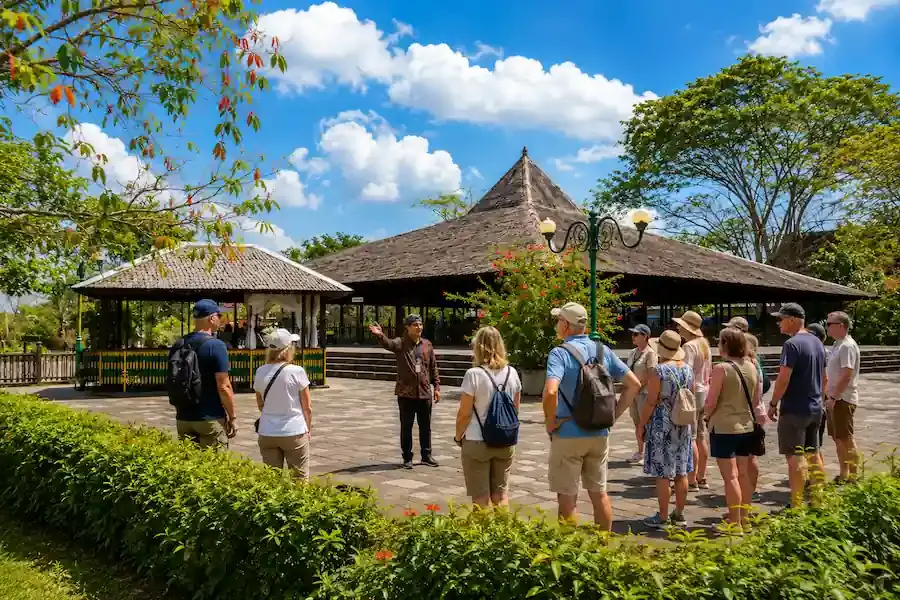
Today, Candi Agung is one of the most popular historical attractions in South Kalimantan. Its spacious, clean, and well-maintained grounds allow visitors to enjoy a comfortable atmosphere while learning about regional history.
Every holiday season, thousands of visitors from across Kalimantan come to see firsthand the site they previously knew only from history books and folklore.
Many visitors also come to learn more about the origins of the Banjar Kingdom and the traces of Majapahit influence on the island of Kalimantan.
The combination of gardens, pavilions, a museum, and archaeological remains makes Candi Agung an ideal destination for family trips, educational tourism, and historical research.
A Symbol of the Beginning of Banjar Civilization
More than just a tourist attraction, Candi Agung stands as a silent witness to the long journey of the Banjar people from the era of Hindu kingdoms to the rise of an influential Islamic sultanate in Kalimantan.
Behind its ancient remains lie the stories of Ampu Jatmika, Lambung Mangkurat, Putri Junjung Buih, and Prince Suryanata, figures who played crucial roles in shaping Banjar cultural identity.
It is no exaggeration to describe Candi Agung as one of the most valuable historical sites in South Kalimantan.
For anyone wishing to understand the roots of Banjar history and the development of civilization on the island of Kalimantan, a visit to Candi Agung in Amuntai offers a journey through a living past that continues to endure today.