
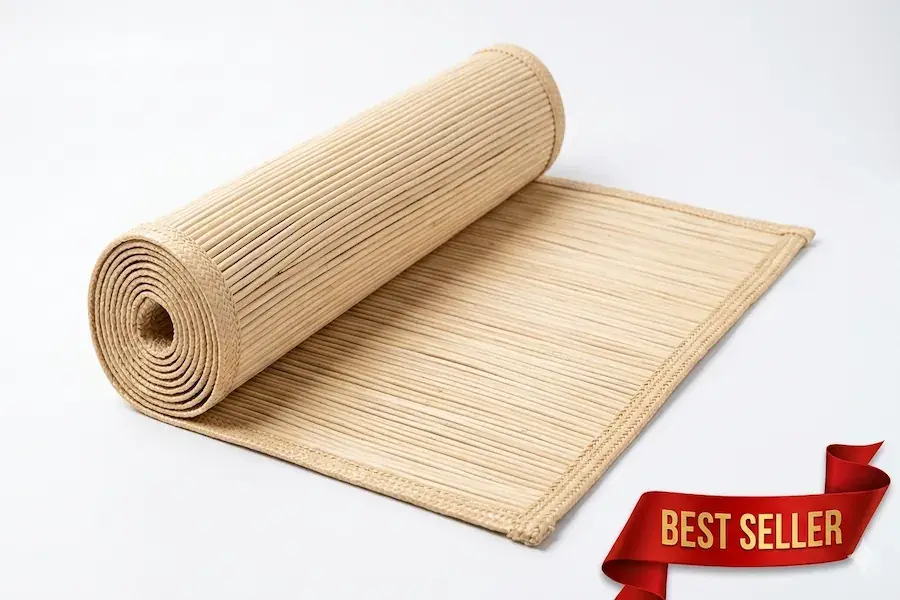
A Cool, Durable Banjar Rattan Mat That Remains Popular Today
Amid the abundance of mass-produced modern mats and floor coverings, the people of South Kalimantan still preserve a traditional craft that has stood the test of time. This craft is known as Lampit Rotan Amuntai, a traditional woven rattan mat that has been an integral part of Banjar life for generations.
For the Banjar people, a lampit is more than just a floor mat. This woven rattan mat has long been used as a place for family gatherings, welcoming guests, sharing meals while sitting on the floor, and supporting various social and cultural activities. Beyond its practical function, lampit also brings a natural atmosphere that makes a room feel warmer, more comfortable, and closely connected to local traditions.
A Craft Heritage from Amuntai
Lampit rattan mats originate from the city of Amuntai, the capital of Hulu Sungai Utara Regency in South Kalimantan. The area has long been recognized as one of the largest centers of rattan craftsmanship in the Banjar region. Through the skilled hands of local artisans, wild rattan stems harvested from the forests are transformed into woven mats that are strong, beautiful, and economically valuable.
According to local tradition, the name "lampit" comes from Pelampitan Village, a community where residents have practiced rattan mat weaving for generations. Over time, the term lampit became widely used to refer to the various types of traditional rattan mats produced in Amuntai, which are now known throughout Indonesia.
Originally, this craft was produced entirely as a home-based industry. Nearly every step was carried out by hand, from selecting raw materials, cleaning the rattan, removing the thorns, splitting the rattan into uniform strips, and weaving them into durable and comfortable mats.
A Manufacturing Process That Requires Patience
One reason why lampit rattan mats are highly valued is the complexity of their production process. Creating a single high-quality lampit can take an artisan between one and two months to complete.
The rattan stems must first be carefully selected. They are then cleaned, split, trimmed to uniform sizes, and woven one by one to create a dense and sturdy mat surface. Every stage requires great precision, as even a small mistake can affect the strength and appearance of the final product.
As market demand continued to grow, artisans in Amuntai began developing more efficient production methods. This innovation led to the creation of a variant known as Lampit Saburina, a type of lampit produced with machine assistance using rattan skin as its primary material.
This technological advancement allows production to be completed more quickly while preserving the essential character of traditional Amuntai rattan craftsmanship.
Shapes and Characteristics of Lampit Rattan Mats
Lampit mats are generally rectangular or square in shape and come in a variety of sizes. Some are small enough to serve as plate mats or table coverings, while larger versions are used in living rooms and family gathering spaces.
The mats typically retain the natural color of rattan, ranging from light brown to dark brown. This natural appearance is one of their main attractions, creating a warm, simple, and nature-inspired aesthetic. Some artisans also incorporate rumbia fibers or natural dyes to create more decorative patterns.
Unlike traditional lampit mats, Lampit Saburina features a neater and more modern appearance. Its weave is made from rattan skin combined with nylon thread, while the underside is lined with cotton fabric to enhance comfort and durability.
Part of Banjar Floor-Seating Culture
In Banjar culture, the tradition of sitting and dining together on the floor remains common today. This is why lampit mats continue to play an important role in everyday life.
Lampit mats are frequently used as seating mats when welcoming guests, during family gatherings, and while sharing meals. They are also used as table coverings, additional sleeping mats, wall decorations, and decorative elements in traditional or ethnic-style homes.
Their practicality and durability have allowed lampit mats to remain relevant despite the wide variety of modern products available today.
Simple Yet Elegant Patterns
Unlike many traditional textiles that carry specific symbolic meanings, lampit rattan mats emphasize the beauty of their woven patterns. Their uniqueness lies in the arrangement of rattan strips that create lines, crisscross designs, and combinations of natural materials that produce distinctive textures.
There are no strict pattern rules indicating social status, as found in some traditional Indonesian textiles. However, the quality of the weaving, the neatness of the craftsmanship, and the complexity of the pattern often serve as indicators of a lampit's quality.
The finer the craftsmanship, the higher the value of the product.
Lampit Rotan Amuntai and Lampit Saburina
Although both originate from Amuntai, Lampit Rotan Amuntai and Lampit Saburina have distinct characteristics.
Lampit Rotan Amuntai is made from whole rattan stems woven using traditional techniques. The process takes longer, the finished product is heavier, and it possesses a strong ethnic character. These mats are highly appreciated by enthusiasts of traditional crafts because they preserve ancestral weaving techniques.
Lampit Saburina, on the other hand, uses rattan skin processed with machine assistance. The result is lighter, neater, and more modern in appearance. The edges are typically reinforced with polypropylene tape, while the underside is lined with cotton fabric, making it suitable for both home decoration and formal living-room settings.
In other words, Amuntai is the place of origin of lampit craftsmanship, while Saburina is one of its modern variations developed through the innovation of local artisans.
A Leading Craft Product Reaching International Markets
Today, lampit rattan mats are marketed far beyond South Kalimantan. They are regularly shipped to major Indonesian cities such as Jakarta, Surabaya, Medan, and Yogyakarta.
Some artisans have even succeeded in entering export markets in Japan, China, Hong Kong, and South Korea. Growing demand has made lampit one of the most important sources of income for many families in Amuntai.
Through souvenir shops, craft galleries, and various digital marketplaces, lampit rattan mats have become increasingly accessible to buyers from across Indonesia and around the world.
Why Do Lampit Rattan Mats Feel Cooler?
One of the main advantages of lampit compared to synthetic mats is its comfort in tropical climates.
Rattan has a natural ability to promote air circulation, allowing its surface to feel cooler when used. The woven structure is not overly dense, enabling air to move freely through the material and reducing the feeling of heat and humidity.
For this reason, many people consider lampit more comfortable than plastic mats or synthetic floor coverings, which tend to retain heat. As long as it is not exposed to direct sunlight for extended periods, a lampit mat generally remains cool and pleasant to sit on.
A Cultural Heritage That Continues to Endure
Amid changing lifestyles and the rapid growth of modern industries, Lampit Rotan Amuntai remains one of the most recognizable symbols of Banjar craftsmanship. The beauty of its weaving, the strength of its natural materials, and the cultural values embedded within it make lampit more than just a floor mat. It is also a reflection of the skill, creativity, and perseverance of the people of South Kalimantan.
Whether in its traditional form or through innovations such as Lampit Saburina, this craft demonstrates that cultural heritage can continue to evolve without losing its identity. From the living rooms of Banjar homes to international markets, Lampit Rotan Amuntai remains a source of pride, showcasing the richness of South Kalimantan’s culture and local wisdom to the world.