
The Most Important Religious and Historical Tourist Destination in Banjarmasin
The Legacy of the First Sultan of the Banjar Sultanate, and the Beginning of Islamic History in South Kalimantan
In the Kuin Utara area, right on the banks of the Kuin River, which has served as one of the lifelines of the Banjar people for centuries, stands a burial complex of immense historical significance to South Kalimantan.
This site is the Tomb of Sultan Suriansyah, the burial place of the first ruler of the Banjar Sultanate and the first Banjar leader to embrace Islam.
The tomb complex is located on Jalan Kuin Utara RT 09, Kuin Utara Village, North Banjarmasin District, Banjarmasin City. It is situated not far from the Kuin River and only about 500 meters from Sultan Suriansyah Mosque, renowned as the oldest mosque in South Kalimantan.
From downtown Banjarmasin, the tomb can be reached in approximately 10 to 15 minutes by car or motorcycle.
However, visitors who wish to experience the unique atmosphere of the City of a Thousand Rivers can also travel to the site by water using a traditional klotok boat from the Martapura River waterfront area.
This river journey offers a distinctive experience, allowing visitors to observe the riverside way of life that continues to thrive to this day.
Today, the Tomb of Sultan Suriansyah remains one of the most visited religious tourism destinations in South Kalimantan. In addition to local residents, the site frequently welcomes pilgrims from various regions of Indonesia as well as from neighboring countries such as Brunei Darussalam and Malaysia.
Raden Samudera, the Figure Who Changed the Course of Banjar History
The name Sultan Suriansyah holds a highly significant place in the history of South Kalimantan. Before becoming a sultan, he was known as Raden Samudera. He was the grandson of Maharaja Sukarama, the ruler of the Negara Daha Kingdom, once a major kingdom in the South Kalimantan region.
During his lifetime, Raden Samudera successfully established the Banjar Sultanate and later ascended the throne as its ruler. After becoming king, he became widely known as Prince Samudera.
The most historic event occurred in 1526 CE (963 AH) when Prince Samudera converted to Islam. His conversion was guided by Khatib Dayan, an Islamic scholar who came from the Demak Sultanate.
After embracing Islam, Prince Samudera changed his name to Sultan Suriansyah. In various historical sources, he is also known by several other names, including Suryanullah, Sultan Suria Angsa, and Panembahan or Susuhunan Batu Habang.
Sultan Suriansyah ruled the Banjar Sultanate for approximately 24 years, from 1526 to 1550 CE. His reign marked the beginning of the spread of Islam in South Kalimantan and the establishment of the Banjar Sultanate as an Islamic kingdom.
Because of his tremendous contribution, September 26, 1526, was later designated as the founding date of Banjarmasin City. This date commemorates the beginning of Sultan Suriansyah’s reign, which is regarded as the starting point of modern Banjarmasin’s identity.
The Major Role of Khatib Dayan in the Spread of Islam in Banjar
When discussing the history of Sultan Suriansyah, the name Khatib Dayan cannot be separated from the story. This Islamic scholar from the Demak Sultanate played a crucial role in the development of Islam in Banjar.
Khatib Dayan is believed to have been a descendant of Sunan Gunung Jati of Cirebon. He guided Raden Samudera in embracing Islam and later actively spread Islamic teachings throughout the Banjar region until the end of his life.
In recognition of his contributions, the tomb of Khatib Dayan is also located within the Sultan Suriansyah Tomb complex and has become one of the most frequently visited pilgrimage sites in the area.
A Tomb Complex That Preserves the Legacy of Many Important Figures of the Banjar Sultanate
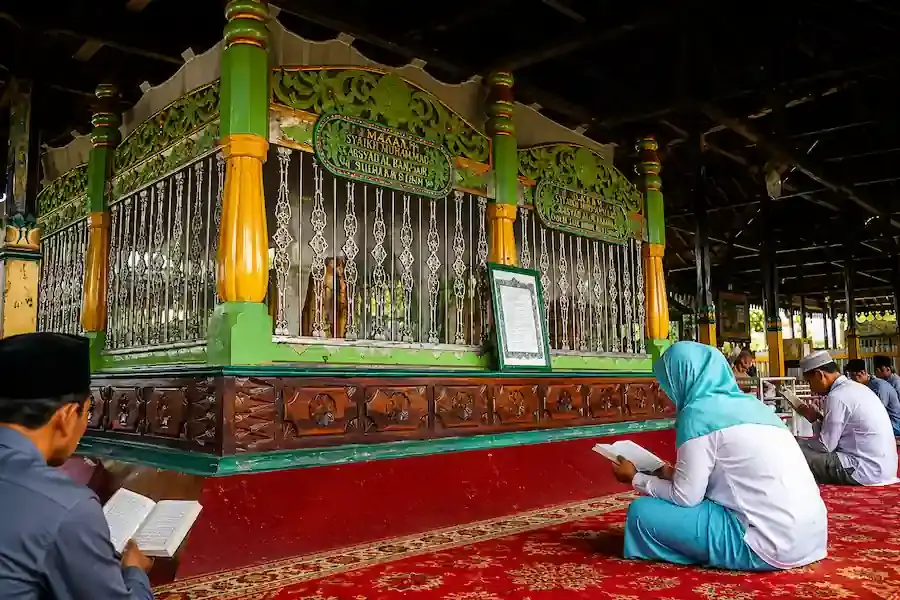
Upon entering the complex, visitors will find an area measuring approximately 50 by 40 meters, containing more than a dozen historic graves sheltered beneath a large mausoleum structure.
The tomb of Sultan Suriansyah is the most prominent among all the graves within the complex. It is the largest tomb, enclosed by a fence measuring approximately 6.4 meters by 3.6 meters by 2.35 meters. Beside it lies the tomb of his mother, Queen Intan Sari.
Not far from the main tomb is the burial place of Sultan Rahmatullah, the son of Sultan Suriansyah, who was also known by the title Sunan Batu Putih.
The complex is also the final resting place of Sultan Hidayatullah I, the grandson of Sultan Suriansyah, who was widely known by the title Sunan Batu Hirang. His tomb features exquisite Jepara-style wood carvings that are highly valued for their artistic beauty and craftsmanship.
In addition to members of the royal family, the complex also contains the tomb of Patih Masih, also known as Kyai Patih Pangeran Djaga Baya, an important figure in Banjar history. Nearby is the tomb of Patih Kuin, who was known by the title Pangeran Jaya Buana.
The burial complex is also the resting place of Putri Galuh Intan Sari, Syaikh Abdul Malik or Tuan H Batu, as well as a grave known locally as the Chinese Child’s Tomb, as inscriptions on the gravestone indicate Chinese ancestry.
Even more intriguing are five unidentified graves whose occupants remain unknown to this day. Several of these graves are located behind the tomb of Sultan Suriansyah.
Several royal commanders and nobles are also buried within the complex, including Prince Muhammad, Prince Ahmad, Sayyid Muhammad, and Gusti Muhammad Arsyad.
The Unique Architecture and Physical Features of the Tomb Complex
The Sultan Suriansyah Tomb Complex features a variety of fascinating architectural elements. All of the graves are enclosed by fences that combine concrete, iron, and ulin wood, adorned with floral ornaments that enhance the beauty of the site.
Most of the gravestones are made of wood and stand approximately 40 centimeters high. A large roof structure shelters all of the graves, the result of restoration work carried out in the mid-1980s.
The restoration history of the site began with studies and research conducted between 1982 and 1983. Construction of a new mausoleum structure followed from 1985 to 1986 to protect the graves from weather-related deterioration.
The presence of an official caretaker continues to help preserve the site, ensuring that it remains clean, well-maintained, and comfortable for visitors and pilgrims.
The complex also provides a spacious parking area for visitors. In addition, there is a modest museum containing historical information, although its collection is still being expanded and developed.
A riverside dock is also available for visitors who arrive by boat through the river route.
A Pilgrimage Tradition Preserved Through Generations
As one of the most important religious sites in South Kalimantan, the Tomb of Sultan Suriansyah consistently attracts large numbers of visitors throughout the year.
Most visitors come to offer prayers and pay their respects to Sultan Suriansyah and the other prominent figures buried within the complex. Many Islamic study groups also regularly organize collective prayer gatherings at the site.
The tradition of scattering flower petals is another common practice. Flowers are typically placed on the graves of Sultan Suriansyah, Khatib Dayan, Patih Masih, and other notable individuals buried within the complex.
Beyond religious purposes, many visitors come to learn about the history of the Banjar Sultanate and gain a deeper understanding of the key figures who contributed to the spread of Islam in South Kalimantan.
The complex is particularly crowded during the Eid holiday season, when family pilgrimage traditions are still widely observed among the Banjar community. It also serves as the official pilgrimage destination for the Banjarmasin City Government and the Regional Leadership Coordination Forum during the annual anniversary commemorations of Banjarmasin City.
To preserve the sanctity of the site, visitors are encouraged to wear modest clothing. Islamic attire is the most common choice, especially among female pilgrims who often visit together with their children and families.
Interestingly, visitors can enter the entire complex free of charge, with no entrance fees or parking fees, making this historical attraction accessible to everyone.
Sultan Suriansyah Mosque, the Oldest Mosque in South Kalimantan
A visit to the Tomb of Sultan Suriansyah would not be complete without stopping by Sultan Suriansyah Mosque, located approximately 500 meters from the tomb complex.
The mosque is one of the oldest Islamic structures in South Kalimantan and is believed to have been built shortly after Sultan Suriansyah embraced Islam in 1526.
For nearly five centuries, the mosque has witnessed the development of Islam in the Banjar region. Major renovations were undertaken in 1976 and again in 1999 to preserve this important historical landmark.
Ulin Wood Architecture That Has Endured for Nearly Five Centuries
One of the mosque’s greatest distinctions is its extensive use of ulin wood as the primary construction material. Nearly every part of the building—including the walls, doors, windows, terrace railings, flooring, and roofing structure—is made from this remarkable hardwood.
Often referred to as ironwood, ulin is renowned for its exceptional strength, resistance to water, durability against changing weather conditions, and ability to last for centuries.
The mosque is built on stilts, a characteristic feature of traditional Banjar architecture. Its roof is covered with ulin wood shingles, further enhancing its traditional appearance.
The Three-Tiered Roof, an Icon of Ancient Banjar Mosques
The most striking feature of the mosque is its three-tiered roof, locally known as tumpang talu, which has become a hallmark of historic mosques throughout South Kalimantan.
This roof design reflects a strong architectural influence from the Great Mosque of Demak in Java. Traditional decorative ornaments known as sungkul and jamang adorn the upper sections of the roof, adding elegance to the structure.
Beyond its aesthetic appeal, the multi-tiered roof also carries spiritual symbolism closely associated with the development of Islam across the Indonesian archipelago.
A Unique Mihrab Symbolizing the Six Pillars of Faith
Another rare feature seldom found in other mosques is the mihrab, which has its own separate roof distinct from the main prayer hall.
The mihrab roof takes the form of a pyramid resting on a hexagonal base. This six-sided shape is believed to symbolize the Six Articles of Faith in Islamic teachings.
The structure is also decorated with intricate Banjar-style carvings, making it one of the mosque’s main attractions for visitors interested in traditional architecture.
Islamic Symbolism in Every Corner of the Building
Sultan Suriansyah Mosque features a total of seventeen doors distributed throughout the building. Five are located on the right side, five on the left, five at the rear, and two near the pulpit area.
The mosque is also designed with four symbolic levels, each carrying its own philosophical meaning.
The first level represents Islamic law (Sharia), the second symbolizes the practice of that law, the third represents the essence of Islam, while the highest level—the roof—symbolizes ma'rifat, or the highest level of spiritual knowledge.
Various Arabic calligraphy panels and inscriptions can still be found around the pulpit area. The dominant green tones throughout the interior further reinforce the religious character of this historic building.
The Best Historical Tourism Experience in the Kuin Utara Area
The Kuin Utara area offers a complete cultural and historical tourism experience within a single destination. Visitors can begin their journey by paying respects at the Tomb of Sultan Suriansyah before continuing to Sultan Suriansyah Mosque, which is nearly 500 years old.
From there, the journey can continue to the famous Kuin Floating Market along the Barito River or with a traditional river cruise aboard a klotok boat departing from the nearby dock.
The combination of royal history, Islamic heritage, river culture, and traditional architecture makes Kuin Utara one of the most valuable tourism destinations in South Kalimantan.
For anyone wishing to gain a deeper understanding of Banjar history, the Tomb of Sultan Suriansyah and Sultan Suriansyah Mosque are destinations that deserve a place on every travel itinerary.