

The Architect of South Kalimantan's History
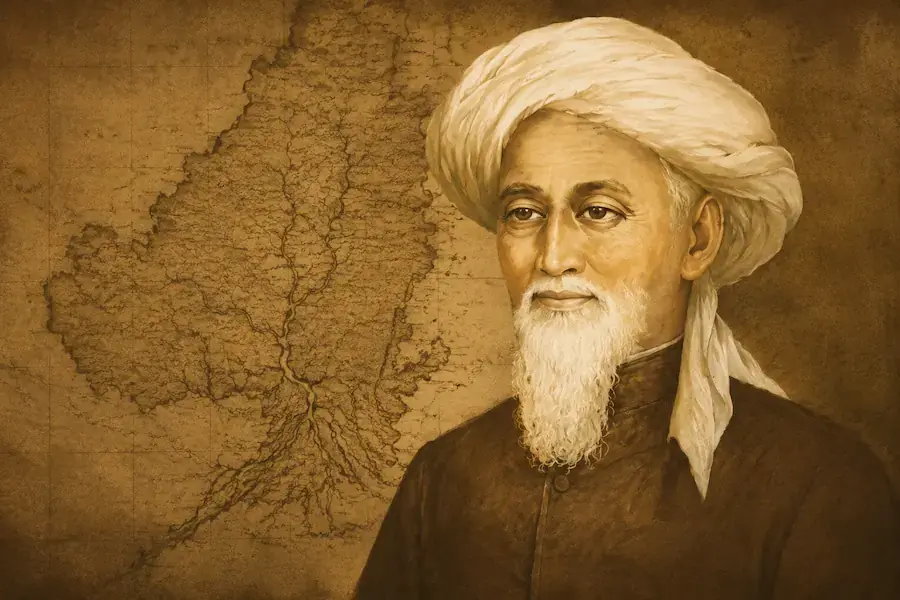
In the history and legends of South Kalimantan, few figures have had an influence as great as Lambung Mangkurat. His name is closely associated with the establishment of the Kingdom of Negara Dipa, the emergence of Putri Junjung Buih, and the formation of a royal lineage that would later give rise to the Kingdom of Negara Daha and the Banjar Sultanate.
For the Banjar people, Lambung Mangkurat is more than just a historical figure. He is a symbol of wisdom, loyalty to ancestral mandates, and a bridge between the local world of Kalimantan and the powerful influence of Majapahit.
The uniqueness of Lambung Mangkurat lies in the fact that he possessed great authority yet chose not to become king. At a time when many sought the throne, he dedicated his life to finding a leader whom he believed had a greater right to rule.
For this reason, in various Banjar chronicles, Lambung Mangkurat is remembered not as a ruler hungry for power, but as the guardian of royal legitimacy.
The Origins of Lambung Mangkurat
According to the Hikayat Banjar, Lambung Mangkurat was the second son of Ampu Jatmika and Dewi Sekar Gading.
Ampu Jatmika himself was an important figure who founded the Kingdom of Negara Dipa in the 14th century. He was known as a wealthy merchant who arrived in Kalimantan through the Nusantara trade networks connected to Majapahit.
In some versions of the story, Ampu Jatmika came from the land of Keling, often associated with the coastal regions of South India. Other versions state that he was a figure closely connected to the Majapahit court in Java.
Lambung Mangkurat grew up in an environment where a new kingdom was being established. From an early age, he witnessed his father’s efforts to unite the various communities living along the rivers of South Kalimantan.
These circumstances shaped Lambung Mangkurat into a leader who understood the importance of diplomacy, unity, and effective governance.
The Meaning of the Name Lambung Mangkurat
The name Lambung Mangkurat is believed to be derived from the local pronunciation of the name Lembu Amangkurat or Dilembu Mangku Rat.
In Banjar tradition, changes in the pronunciation of names are quite common due to the process of linguistic adaptation from one generation to the next.
The name became widely renowned for centuries after his death. Even today, the name Lambung Mangkurat is used as a symbol of South Kalimantan’s history and serves as the identity of various educational, cultural, and governmental institutions.
More important than the name itself, however, is the legacy of his ideas and his role in building the political foundations of Banjar society.
Ampu Jatmika’s Final Testament That Changed His Life
As Ampu Jatmika approached the end of his life, he faced a significant dilemma.
Although he was the founder of the kingdom, he believed that he did not have the right to occupy the throne because he was not descended from royal or warrior lineage.
In the Hindu-Javanese tradition that influenced the kingdom’s structure at the time, lineage played a crucial role in determining the legitimacy of a ruler.
For this reason, Ampu Jatmika instructed his two sons not to seize the royal crown. Instead, they were to find a leader who possessed the rightful legitimacy to rule the Kingdom of Negara Dipa.
This testament became the turning point in Lambung Mangkurat’s life. He could have ignored his father’s wishes and taken control of the kingdom himself. Instead, he chose a far more difficult path: sacrificing personal ambition in order to preserve the honor of the kingdom.
The Meditation That Gave Birth to a Legend
To fulfill his father’s mandate, Lambung Mangkurat undertook a period of meditation in the river region.
In ancient Banjar tradition, rivers were not merely routes of transportation and trade. They were also regarded as spiritual spaces where humans could connect with the supernatural world.
It was there that Lambung Mangkurat meditated for a long time. According to the Hikayat Banjar, this meditation led to an extraordinary event. From a whirlpool of foam that appeared on the river’s surface emerged a beautiful woman who later became known as Putri Junjung Buih.
This event became one of the most famous legends in the history of South Kalimantan. For the Banjar people, Lambung Mangkurat was not only the discoverer of Putri Junjung Buih but also the figure who paved the way for the birth of a royal dynasty considered legitimate both spiritually and politically.
The Figure Who Elevated Putri Junjung Buih to the Throne
Lambung Mangkurat’s greatest contribution was elevating Putri Junjung Buih as the ruler of Negara Dipa. He understood that the kingdom needed a figure who could be accepted by all people and who possessed strong legitimacy.
After fulfilling the various conditions set by the princess, Lambung Mangkurat brought Putri Junjung Buih to the royal center and crowned her as queen. This decision demonstrated his political maturity. Rather than positioning himself as the supreme ruler, he chose to become a servant of the state and a guardian of governmental stability.
In many traditional sources, Lambung Mangkurat subsequently performed a role similar to that of a grand vizier or prime minister who managed the day-to-day affairs of government.
Lambung Mangkurat’s Relationship with Majapahit
Lambung Mangkurat’s role was not limited to South Kalimantan alone. In Banjar tradition, he is also closely connected to Majapahit, the largest kingdom in the Indonesian archipelago at the time.
After Putri Junjung Buih was crowned queen, Lambung Mangkurat sought a suitable consort for the ruler.
His search led him to a Majapahit nobleman named Prince Suryanata. The marriage between Putri Junjung Buih and Prince Suryanata carried enormous political significance. It united the local legitimacy of Kalimantan with the political prestige of Majapahit.
Through this marriage, Negara Dipa gained a stronger position within the network of power across the Indonesian archipelago. As a result, Lambung Mangkurat is often regarded as a diplomat who successfully bridged two great worlds: the river civilization of Kalimantan and the royal culture of Java.
The Architect of the Governmental System of Negara Dipa
In addition to his role in royal succession, Lambung Mangkurat is also known as the architect of the governmental foundations of Negara Dipa. Under his leadership, the kingdom was divided into subordinate regions administered by local officials.
This system enabled the kingdom to control vast territories even though many areas were separated by rivers, swamps, and forests. Such an approach demonstrated remarkable administrative capabilities for its time.
Many local historians view the governmental model established during Lambung Mangkurat’s era as the precursor to the administrative structures that later developed under the Kingdom of Negara Daha and the Banjar Sultanate.
Lambung Mangkurat as a Symbol of Banjar Leadership
In Banjar culture, Lambung Mangkurat is often portrayed as the ideal leader. He possessed power, yet he was not tempted to become an absolute ruler.
He had military capability but preferred diplomacy. He had the opportunity to become king but chose to honor his father’s mandate. These qualities set Lambung Mangkurat apart from many other royal figures.
His life story teaches that leadership is not always synonymous with wearing a crown. A person can become one of the most influential figures in history without ever sitting on a throne.
The Legacy of Lambung Mangkurat That Endures Today
Although there is no personal palace or monumental tomb that can be definitively identified as belonging to Lambung Mangkurat, his historical legacy can still be found throughout South Kalimantan.
The most famous legacy is the Candi Agung site in Amuntai. This archaeological site is closely linked to the history of Negara Dipa and serves as one of the key pieces of evidence for the existence of an ancient center of power in the region.
The name Lambung Mangkurat has also been immortalized in various important institutions across South Kalimantan. One of the most notable is the Lambung Mangkurat Museum, which houses extensive collections related to Banjar history and culture.
The museum serves as a center for documenting the long journey of South Kalimantan’s people, from prehistoric times to the modern era. In addition, the name Lambung Mangkurat lives on through folk tales, traditional performing arts, literary works, and the cultural identity of the Banjar people.
The Greatest Legacy of Lambung Mangkurat
If Putri Junjung Buih is regarded as the ancestor of the Banjar kings, then Lambung Mangkurat can be considered the architect who designed the birth of that civilization. He did not leave behind a dynasty. He did not establish a kingdom bearing his own name.
Instead, he left something far greater: political foundations, the legitimacy of power, systems of governance, and a cultural identity that became the basis for the emergence of Negara Daha and the Banjar Sultanate.
For this reason, in the history of South Kalimantan, Lambung Mangkurat is more than just a legendary figure. He is the central character who connects the early era of Negara Dipa, the emergence of Putri Junjung Buih, the influence of Majapahit, and the formation of the Banjar civilization that is still recognized today.