
A Great Banjar Scholar Who Shaped the Islamic Civilization of the Malay Archipelago
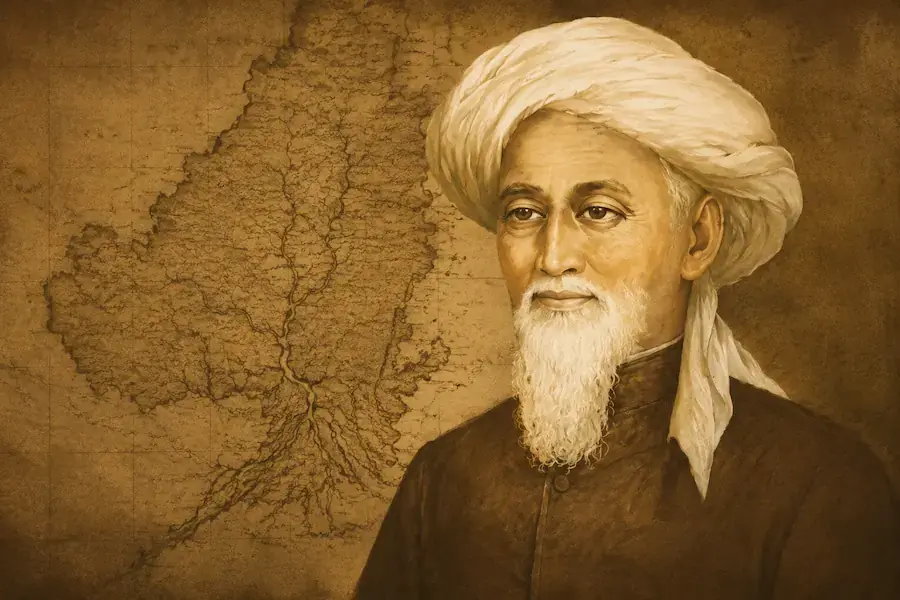
Among the prominent figures ever born in South Kalimantan, Shaykh Muhammad Arsyad al-Banjari holds a truly distinguished position. Known by the title Datu Kalampayan, he was not only a great scholar from the Land of Banjar but also a figure whose influence extended widely across the development of Islam throughout the Malay Archipelago and the broader Malay world.
Through his intellectual contributions, written works, educational efforts, and reforms in Islamic law, Shaykh Arsyad established a scholarly foundation whose benefits continue to be felt to this day. His influence was not limited to the Banjar Sultanate but also reached various regions across Southeast Asia.
Born in Lok Gabang, Raised to Become a Great Scholar
Shaykh Muhammad Arsyad al-Banjari was born with the name Sayyid Ja'far Al-Adarus on 15 Safar 1122 AH, corresponding to March 17, 1710, in Lok Gabang Village, an area that is now part of Astambul District, Banjar Regency, South Kalimantan.
He was the son of Abdullah and Siti Aminah, a devout Muslim couple. From an early age, Arsyad received religious education directly from his parents. Within the family environment, he began learning the fundamentals of Islamic monotheism (tawhid) and reading the Holy Qur'an.
In addition to being renowned as a great scholar, Shaykh Arsyad was also a descendant of the Prophet Muhammad (peace be upon him) through the lineage of Sayyidina Ali ibn Abi Talib and Sayyidatina Fatimah. This lineage placed him among the respected family of sayyids, who were known for their strong tradition of Islamic scholarship.
However, what made his name endure through history was not merely his ancestry, but rather the breadth of his knowledge and his dedication to building and nurturing an Islamic society.
Became the Foster Child of the Sultan of Banjar
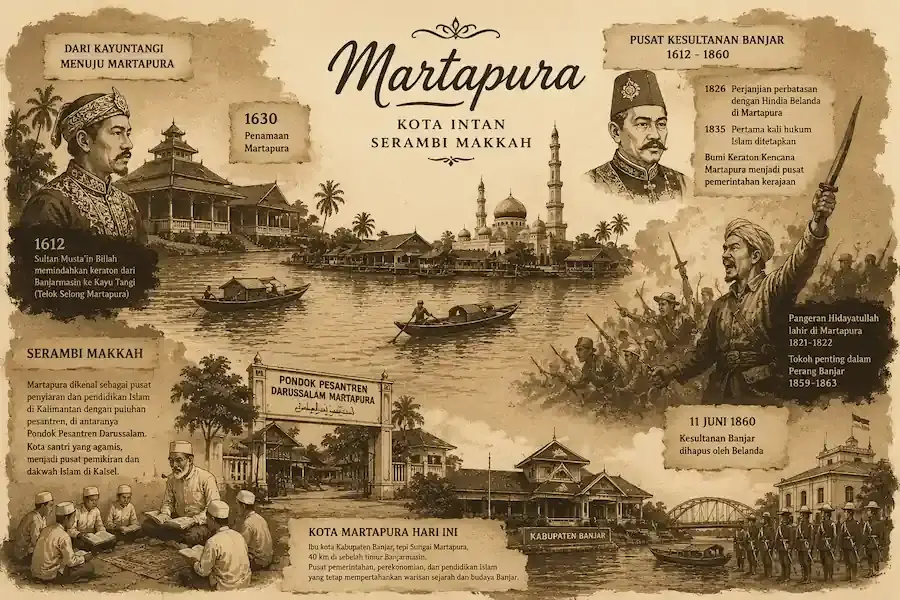
The course of Shaykh Arsyad’s life changed when he was around six years old. On one occasion, the 10th Sultan of Banjar, Sultan Tahlillah, visited Lok Gabang Village and noticed the extraordinary intelligence of a young boy named Arsyad.
His remarkable intellect captured the Sultan’s attention. After speaking with Arsyad’s family, Sultan Tahlillah requested permission to bring the child to the Martapura Palace so that he could receive a better education.
From that moment onward, Arsyad grew up as a foster child within the royal household of the Banjar Sultanate. Life at the palace provided him with access to education, an intellectual environment, and guidance that would later become essential provisions for his life's journey.
The relationship between Shaykh Arsyad and the Banjar Sultanate, established from his childhood, eventually developed into a close partnership between religious scholars and the state that continued through several generations of Banjar rulers.
Pursuing Knowledge for Decades in Makkah and Madinah
Recognizing the Banjar Sultanate’s need for scholars with strong religious authority, Sultan Tahmidullah later made a significant decision. In 1740, when Arsyad was approximately 30 years old, he was sent to the Holy Land to deepen his Islamic studies.
This journey was far more than an ordinary educational expedition. It became one of the greatest intellectual investments ever undertaken by the Banjar Sultanate.
For approximately three decades—according to some sources, as long as 33 years—Shaykh Arsyad studied in Makkah and Madinah. He spent this extensive period learning from the distinguished scholars of the Two Holy Cities (Haramayn) and mastering various branches of Islamic knowledge.
There, he studied Islamic jurisprudence (fiqh), Qur’anic exegesis (tafsir), hadith, theology (tawhid), Sufism (tasawwuf), principles of jurisprudence (usul al-fiqh), astronomy (ilm al-falak), Arabic language, and many other disciplines. Overall, he was recognized as having mastered more than 32 fields of Islamic scholarship.
Moreover, he obtained scholarly chains of transmission (sanad) that connected back to the Prophet Muhammad (peace be upon him) through his teachers. This scholarly authority later established Shaykh Arsyad as one of the most respected Islamic scholars in the Malay world.
Interestingly, the funding for his education did not end under a single reign. The scholarship provided by the Banjar Sultanate was continued by several successive sultans, demonstrating the kingdom’s deep commitment to the advancement of knowledge and Islamic education.
Returning to Banjar and Appointed as the Sultanate's Mufti
Around 1772 or 1773, Shaykh Muhammad Arsyad al-Banjari returned to the Land of Banjar after spending decades pursuing knowledge in the Haramain.
His return was welcomed with great honor. During the reign of Sultan Tahmidullah, he was appointed as the Mufti of the Banjar Sultanate, the highest authority in religious and legal affairs.
This appointment was not merely a recognition of his scholarship but also a strategic step toward strengthening a system of governance based on Islamic law within the Banjar Sultanate.
In addition to serving as mufti, Shaykh Arsyad was entrusted as a royal advisor on various legal, social, and political matters. His influence was so significant that many state policies were shaped by his ideas and religious perspectives.
This close relationship grew even stronger when Sultan Tahmidullah married Shaykh Arsyad to Ratu Aminah, the Sultan’s niece. From that point onward, the bond between the great scholar and the royal family was not only intellectual but also familial.
Establishing the First Sharia Court in the Banjar Sultanate
As mufti, Shaykh Arsyad did more than teach Islamic knowledge to the people. He also carried out highly significant institutional reforms.
One of his greatest achievements was establishing a Sharia Court system that functioned as the official religious judiciary of the Banjar Sultanate.
Through this institution, the offices of mufti and qadhi were organized more systematically, allowing Islamic law to be implemented more effectively in both society and government.
This initiative became an important milestone in the history of Islamic law in South Kalimantan and positioned the Banjar Sultanate as one of the Islamic kingdoms with a more structured legal system.
Founding the Dalam Pagar Islamic Boarding School
Recognizing that the continuity of knowledge depended on education, Shaykh Arsyad established an Islamic learning center that would later become one of the most influential educational institutions in Kalimantan.
With the support of Sultan Tahmidullah, who granted him a parcel of land approximately four kilometers from Martapura, he founded the Dalam Pagar Islamic Boarding School (Pondok Pesantren Dalam Pagar) together with Shaykh Abdul Wahab Albugisi.
This institution was not merely a place for religious study but also a center for training scholars, judges, qadhis, and community leaders. From this institution emerged generations of scholars who spread Islamic knowledge throughout Kalimantan and the wider Malay Archipelago.
To this day, Dalam Pagar is remembered as one of the most important centers of Islamic intellectual development in Banjar history.
Sabilal Muhtadin: A Masterpiece of Global Renown
Among the many legacies of Shaykh Arsyad al-Banjari, none is more famous than his work Sabilal Muhtadin Lit Tafaqquh fi Amriddin.
The book was written at the request of Sultan Tahmidullah around 1779 and completed several years later. It presents the jurisprudence of the Shafi'i school in a systematic manner and was written in the Malay language to make it more accessible to the broader community.
The uniqueness of this work lies in its ability to explain Islamic law while taking into account local social and cultural conditions. Shaykh Arsyad did not merely translate the opinions of Middle Eastern scholars but adapted them to the realities of life in Banjar and the wider Malay Archipelago.
Due to its high scholarly quality, Sabilal Muhtadin later became a primary reference for Shafi'i jurisprudence across various regions of Southeast Asia. It was even used as an academic reference for students studying Southeast Asian Islam in Egypt.
In addition to Sabilal Muhtadin, he authored several other important works, including Tuhfaturraghibin, Ushuluddin, Nuqtatul Ajlan, Kitab Faraidh, and numerous other scholarly writings that demonstrate the breadth of his intellectual expertise.
Influence on the Legal and Political Systems of the Banjar Sultanate
Shaykh Arsyad's role extended beyond education and religious propagation. His ideas also exerted a profound influence on the political and legal direction of the Banjar Sultanate.
His concepts became one of the foundations for various royal regulations based on Islamic law. Many researchers even identify a connection between Shaykh Arsyad’s thought and the emergence of the Sultan Adam Law, which later became one of the most renowned legal codes in Banjar history.
By combining the principles of Islamic law with the social realities of local communities, he successfully shaped a distinctive Banjar Islamic identity—firm in its legal foundations while remaining respectful of local traditions and culture.
This characteristic remains a defining feature of Banjar Islam to this day.
The Scholar Who Became the Teacher of Sultans
Another remarkable aspect of Shaykh Arsyad was the immense respect he received from Banjar rulers. His relationship with the Banjar Sultanate spanned multiple generations, from the reign of Sultan Tahlillah to that of Sultan Sulaiman Rahmatullah.
The sultans were not only patrons and supporters of his da'wah efforts but also students who studied directly under him. Sultan Sulaiman Rahmatullah, for example, is known as one of the rulers who learned from Shaykh Arsyad.
This close relationship even gave rise to a famous testament from Sultan Tahmidullah, who instructed his descendants to always honor Shaykh Arsyad and his family in recognition of their invaluable contributions to the kingdom and the people of Banjar.
Passing Away and a Legacy That Endures
After living for more than a century devoted to da'wah, education, and service to society, Shaykh Muhammad Arsyad al-Banjari passed away on October 3, 1812.
He was laid to rest in Kelampayan Village, Astambul District, Banjar Regency. To this day, his tomb remains one of the most important religious pilgrimage destinations in South Kalimantan.
Although he passed away more than two centuries ago, Shaykh Arsyad’s influence has never truly faded. His works continue to be studied, his teachings remain part of the curriculum in many Islamic boarding schools, and his name is remembered as a symbol of Banjar Islamic scholarship.
Shaykh Muhammad Arsyad al-Banjari and the Revival of Islam in the Malay Archipelago
In the history of Indonesian Islam, Shaykh Muhammad Arsyad al-Banjari was far more than a local scholar from South Kalimantan. He was a reformer who successfully built a bridge between classical Islamic scholarship and the needs of the people of the Malay Archipelago.
Through education, legal reform, the establishment of religious institutions, and his scholarly works, he helped shape the face of Banjar Islam and the wider Malay world for centuries. It is therefore not surprising that many regard him as the Architect of the Islamic Revival in the Malay Archipelago.
From Lok Gabang to the Haramain, from the Martapura Palace to Islamic boarding schools throughout Kalimantan, the legacy of Shaykh Muhammad Arsyad al-Banjari continues to live on as a timeless inheritance of knowledge.